
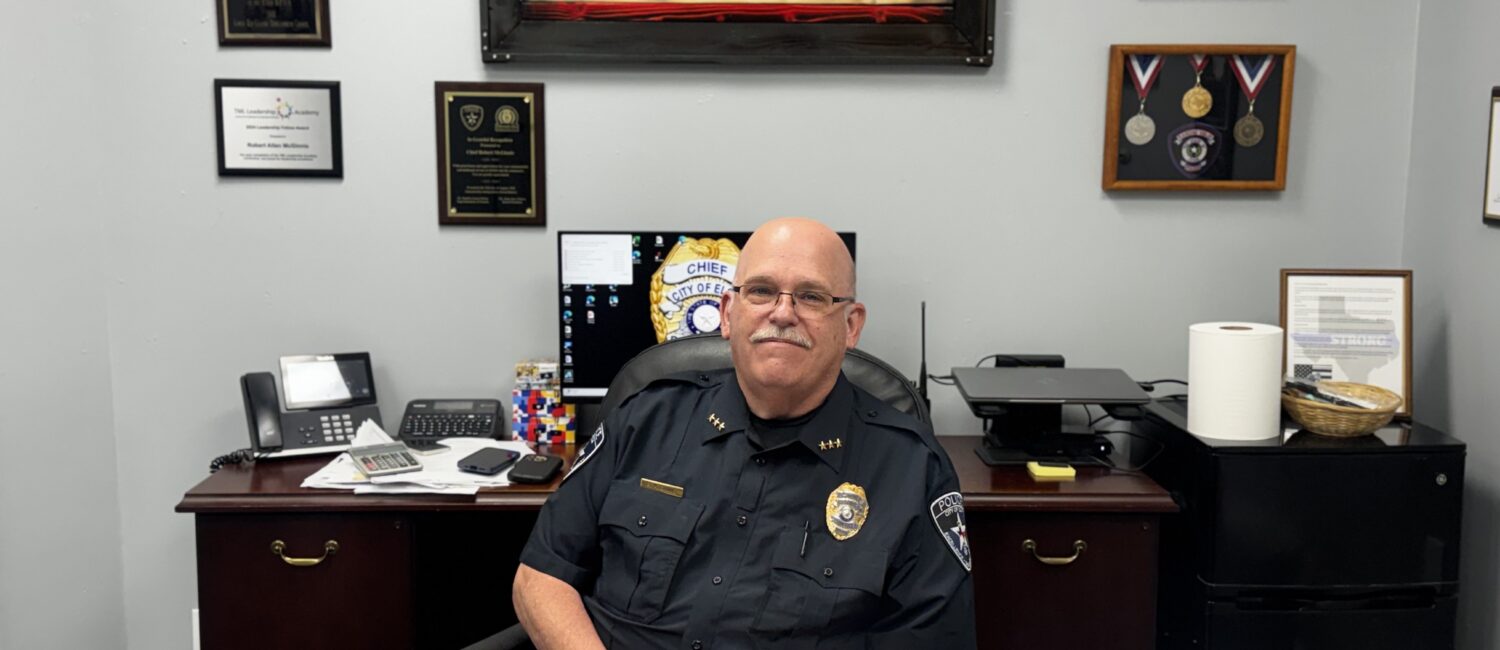
Chief Robert McGinnis has dedicated 35 years to the field of law enforcement, 18 of which have been spent in the role of chief of police. Today, he serves the City of Elsa not only as its top law enforcement officer, but as Director of Public Safety — a role that places him at the helm of the police department, fire department, and emergency management operations simultaneously.
Chief McGinnis began his career in Cameron County and has remained deeply rooted in the Rio Grande Valley throughout his professional life. After a brief tenure as chief of police in Central Texas, he returned to the Valley and, following a short retirement, was drawn back to public service when he learned of an opening in Elsa seven years ago. He has been here ever since.
Leadership Is Not a Title
Chief McGinnis did not set out to lead. He came up through the ranks the way many do — watching the people above him and quietly thinking he could do better. Over time, that curiosity about how things worked, and why, became the foundation of a leadership philosophy that continues to evolve.
“It kind of snuck up on [me],” he said of his rise through the ranks. “I wasn’t the kid who dreamed of being in charge. I just kept wanting to understand more.”
That instinct — to ask why, to seek understanding rather than simply authority — remains central to how he leads today. He is an avid reader on the subject of leadership, drawing from military, business, and public sector perspectives alike. He has completed the State of Texas Certified Public Manager program and regularly pursues leadership development opportunities, not because his role demands it, but because he believes a leader who stops learning stops leading.
When asked about the leaders who have shaped him most, Chief McGinnis doesn’t point to a famous general or a bestselling author. He points to his father.
“Honestly, the person who has influenced my life the most never wrote a book and never led anyone into battle,” he said. “That’s my dad.”
Growing up, McGinnis watched his father show up every day with a quiet, unwavering commitment to doing his work well — not for recognition, but because the people depending on him deserved nothing less. That example left a mark.
“He worked constantly and always tried to improve the product or service he was part of,” McGinnis recalled. “Whether you’re providing a product or a service, it all boils down to the customer. He taught me that.”
It is a lesson McGinnis has carried with him across 35 years of public service — that leadership, at its core, is not about authority. It is about showing up for the people who are counting on
Flexibility Over Formula
When asked about his own leadership style, Chief McGinnis resists easy categorization. He does not believe any single model applies universally, and he is skeptical of leaders who think otherwise.
“I don’t like to get roped into a specific style.” he said. “I think everybody has an answer for that, and maybe it works for them. But to be a good leader, you have to use multiple styles depending on the situation and the person.”
“It depends on who’s standing in front of me and what we’re trying to accomplish. Some people you ask. Some people you tell. The best leaders know the difference.”
Effective leadership requires knowing your people well enough to meet them where they are, to identify what motivates them, and to invest in their growth even when it means preparing them to eventually move on.
The Long View
Perhaps what is most distinctive about Chief McGinnis’s approach to leadership is his willingness to take the long view — to invest in outcomes he may never personally see.
He speaks openly about the reality that meaningful institutional change rarely happens on the timeline of a single leader’s tenure. The work of building a strong organization, a healthy culture, or a more connected community requires planting seeds with no guarantee of being present for the harvest.
“I will not live to see the full benefits of what we’re doing today,” he said. “But that cannot discourage us. What we have to hope for is that the next person who sits in this chair continues down the right path.”
It is a philosophy rooted not in legacy-building, but in stewardship — the belief that leadership is fundamentally about serving something larger than oneself.
“People ask sometimes how it feels to have five bosses instead of one, since I’m appointed directly by the city council. I’ve never looked at it that way.” he said. “We have about 6,000 residents — I technically have 6,000 bosses. We can’t always make everybody happy, but we have to make decisions that benefit the community as a whole, not just certain groups.”
Why Leadership Elsa
Chief McGinnis joined the Leadership Elsa program with a specific purpose: to deepen his connection to the community he serves and to learn from the people building it.
“I want to interact better with the business community,” he said. “To let them know we are a resource — that they can come to us, and we can work together.”
But beyond the practical, he came because he remains, at heart, a student of leadership. He has never taken a course or read a book, he says, without walking away with at least one moment of genuine insight — what he calls the “aha moment.” He joined Leadership Elsa looking for more of those moments, and to contribute his own experience to a community of peers committed to making Elsa better.
Advice for Emerging Leaders
When asked what he would say to future Leadership Elsa participants, Chief McGinnis did not hesitate.
“You have two ears and one mouth. Listen twice as much as you speak.”
It is, he acknowledges, simple advice. But in his experience, it is among the most difficult for leaders to actually follow — and among the most important.
“As leaders, we can fall into the trap of believing we have all the answers. We don’t. I try to surround myself with people smarter than me, because I know I don’t know everything. The leaders I respect most have always understood that.”